Nobody Thinks Like You
How projection and false consensus quietly shape every decision
TL;DR:
Your brain assumes other people think like you. They don't. That assumption runs silently underneath every design decision you make, and knowing about it doesn't fix it. The only way out is through evidence, not instinct.
Think about the last design decision you made without testing it. Maybe you chose a layout because it felt clean. Picked a label because it seemed obvious. Cut a feature because you couldn’t imagine anyone needing it. You probably called that instinct. You might even have called it experience.
It wasn’t. It was you, designing for yourself, in a room full of people who are nothing like you.
This is not a personality flaw. It is not something that more experience will fix. It is a documented feature of how human perception works, and it runs underneath every design decision you have ever made without even announcing itself.
The brain’s favourite shortcut
In 1977, Lee Ross, David Greene, and Pamela House at Stanford ran a series of experiments on what they called the false consensus effect. They gave people ordinary, unremarkable scenarios — a speeding ticket, a class assignment, a TV commercial — and asked them to predict what most other people would do. Then they asked what the participants themselves would do.
The pattern was clear every time. “Social observers tend to perceive a ‘false consensus’ with respect to the relative commonness of their own responses.” In plain language: whatever you would do, you assume most other people would do the same thing. And whoever would choose differently? You see them as a bit unusual. A bit deviant, even.
That second part matters as much as the first. Ross and his colleagues did not just find that people overestimate agreement. They also found that people who chose differently from the participant were judged to have more extreme, more revealing personality traits. The person who pays the speeding ticket assumes most people would pay it — and also assumes that someone who contests it in court must be the kind of person who loves conflict, or is paranoid about authority, or has something to prove. The same logic runs in reverse. The person who contests it thinks you are a pushover for not fighting back.
Both groups are doing the same thing: starting from their own choice, assuming it is the normal one, and then explaining away anyone who behaves differently by making it about their character rather than their context.
This is exactly what happens in design reviews. Someone builds a navigation pattern that makes sense to them and then describes users who cannot find their way around as “not our target user” or “low tech literacy.” Someone writes microcopy that feels obvious to them and assumes people who misread it simply were not paying attention. The false consensus effect does not just make you wrong about what users want — it makes you explain away evidence that you are wrong, because you have already decided that the people who behave differently are the outliers.
The mechanism is not vanity. It is availability. Your own preferences, habits, and reactions are the most accessible data you have about how humans behave. You have felt them. You have lived them. They feel like ground truth. So when your brain needs to estimate what is normal, it reaches for the nearest example it can find — you — and builds its model of the world from there.
Designers do this constantly. You experience your own product with your own knowledge, your own patience, your own tolerance for ambiguity. You know where everything is because you put it there. You understand the terminology because you wrote it. You feel good about the interaction because it matches how you think. And because your brain is doing this quietly, running in the background without flagging it, you experience the result not as bias but as confidence.
What it costs
In 2016, a company called Juicero raised $120 million. They built a $400 Wi-Fi-connected juice press that used proprietary packets, priced at around $8 each, to make cold-press juice at home. The founders were convinced this was a mass-market need. They built for people who cared deeply — obsessively, even — about cold-press extraction and the purity of what went into their bodies. People like them. People who had spent years in wellness culture and could not imagine why anyone would drink anything else.
In April 2017, Bloomberg published a video showing that you could get exactly the same juice just by squeezing the packets with your hands. No press required. The product collapsed within months.
The founders were not stupid. They were just designing for themselves and had mistaken their own preferences for universal ones. The false consensus effect does not need a villain. It just needs a team that forgot to ask whether the rest of the world sees what they see.
You might think that is an extreme case. It is not. It is just a case where the gap between the designers and their users was big enough to become expensive. In most products, the same gap exists. It just stays quiet longer.
The mirror you don’t know you’re holding
The harder thing about false consensus is not that it makes you wrong. It is that it makes you wrong while feeling right. And here is what makes it genuinely uncomfortable: knowing about the bias does not make you immune to it. A 1985 meta-analysis of 115 studies confirmed the false consensus effect was highly reliable across contexts. The correlation held whether people knew they were being studied or not. Your brain defaults to similarity. Awareness slows that down a little. It does not stop it.
That is why you cannot design your way out of this through confidence or care. You have to design your way out of it through method.
The shift is simple but not easy. Before you make a decision, name out loud whose preference you are acting on. Not in the abstract — specifically. Is this layout choice based on something you observed in a user? Or is it based on what you would want if you were using this product?
If you hesitate, that hesitation is the answer. It means you are pulling from your own head.
There is a test worth running. After any design choice, ask: would someone who has never encountered this product land here and see what I see? Not would they eventually understand it — would they immediately, without context, read it the way I am reading it? If you cannot say yes with evidence, you are reasoning from your own experience, not theirs.
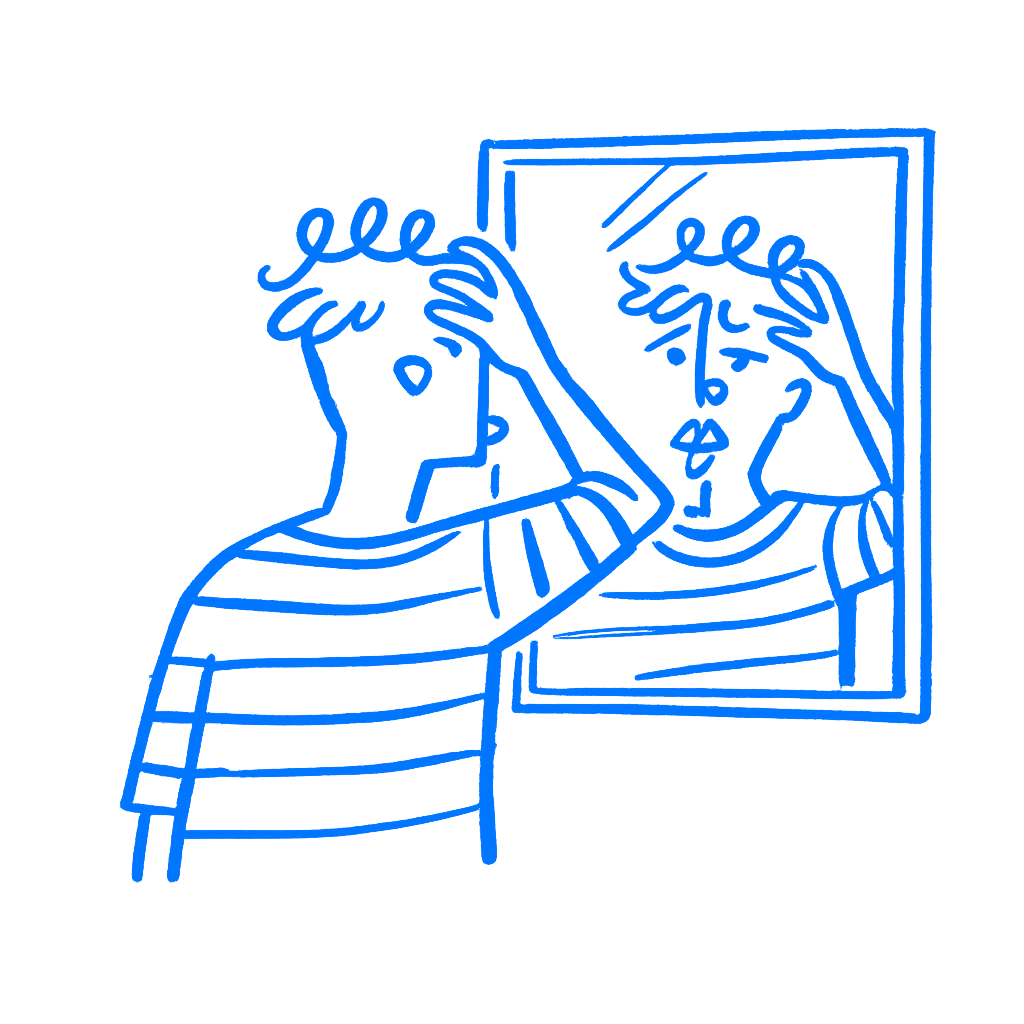
Pay attention also to how you talk about users who struggle. If your first reaction to a failed user test is to describe the participant as confused, distracted, or not representative, you are watching the false consensus effect in real time. The user who does not behave the way you expected is not the outlier. They are the data. The design that only works for people who think like you is not a design — it is a mirror.
This does not mean your instincts are worthless. Pattern recognition built from real observation is valuable. But pattern recognition built from your own preferences, filtered through years of expertise, is just a very confident assumption. And confident assumptions are the most dangerous kind, because they do not feel like assumptions at all.
The most dangerous thing in design is not getting it wrong. It is getting it wrong and feeling completely certain you got it right.
⸻